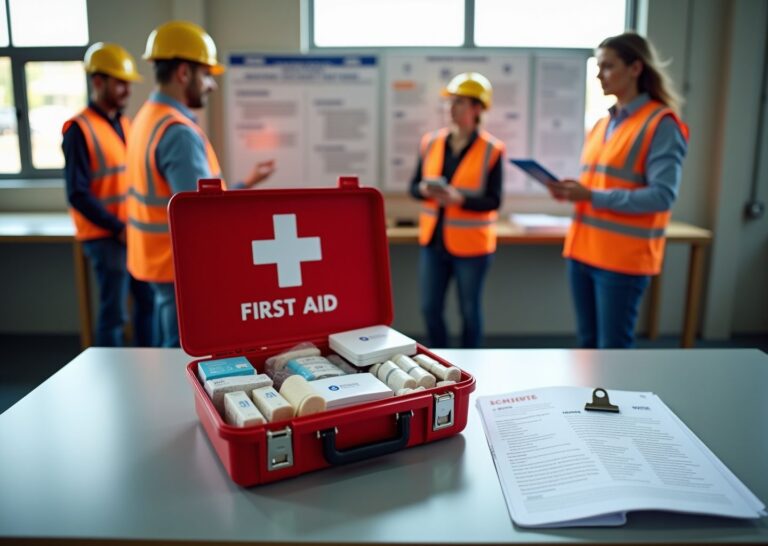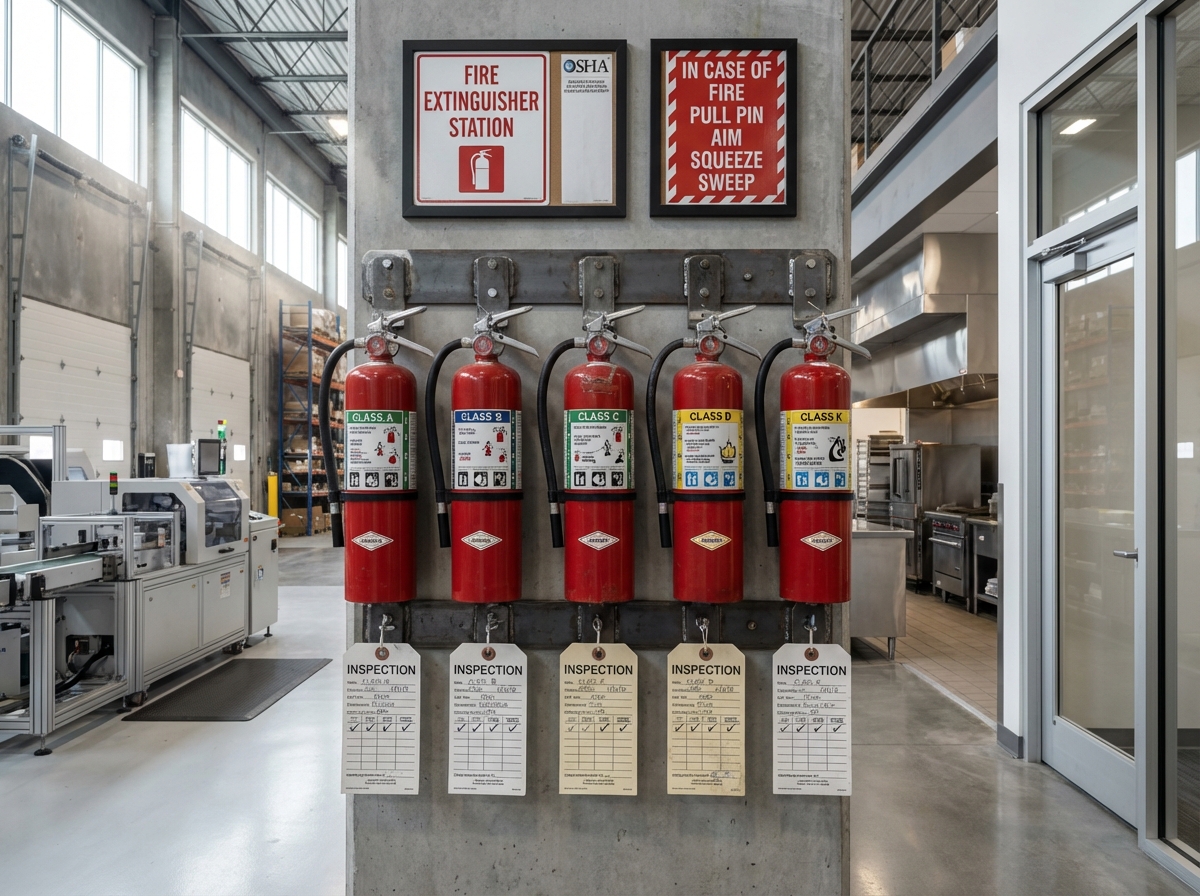
Workplace fire safety starts with the right extinguisher in the right place. This article breaks down Class A, B, C, D, and K extinguishers, explains OSHA and NFPA requirements for selection and placement, and provides practical checklists and templates to help manufacturing, construction, warehouse, and office managers meet OSHA standards and reduce fire risk.
Understanding Fire Extinguisher Classes and How They Work
Selecting the right fire extinguisher starts with identifying the specific fuels present in your work area. OSHA 1910.157 requires employers to provide extinguishers based on the classes of anticipated fires. Using the wrong agent can be ineffective; in some cases, it can make the fire much more dangerous. You must match the extinguisher to the hazard to ensure employee safety and regulatory compliance. The NFPA 10 standard provides the technical framework for these classifications. You should always consult the latest edition of NFPA 10 for specific technical requirements.
Class A Ordinary Combustibles
Fuels and Fire Types
Class A fires involve common materials that leave an ash residue. These include wood, paper, cloth, rubber, and many types of plastics. You will find these hazards in almost every workplace. An office copier room is a perfect example, as it contains large volumes of paper and plastic components. Warehouses with cardboard packaging also fall into this category.
Extinguishing Agents and Suppression
Water is the most common agent for Class A fires. It works through physical cooling, absorbing the heat from the fuel and bringing it below the ignition temperature. Multipurpose dry chemical extinguishers using monoammonium phosphate are also widely used. This agent suppresses the fire by melting and coating the fuel, creating a physical barrier that cuts off oxygen and prevents re-ignition. Foam agents can also be used to soak the material and provide cooling.
Limitations and Risks
You should never use a standard water extinguisher on grease or electrical fires. Water conducts electricity and will cause a shock hazard. It will also cause burning oil to splash and spread the fire rapidly.
Class B Flammable Liquids and Gases
Fuels and Fire Types
Class B fires involve flammable liquids and gases. This includes gasoline, oils, oil-based paints, solvents, alcohols, and propane. Manufacturing facilities often have these hazards in paint booths or solvent cleaning stations. A warehouse chemical storage area is another high-risk location. These fires spread quickly because the fuel is often in a liquid state and can flow under doors or into drains.
Extinguishing Agents and Suppression
Carbon dioxide (CO2) is a frequent choice for Class B fires. It works by displacing oxygen, starving the fire of the air it needs to burn. Dry chemicals like sodium bicarbonate or potassium bicarbonate are also effective; these agents interrupt the chemical chain reaction of the flame. Aqueous Film Forming Foam (AFFF) is another option, creating a vapor-suppressing blanket over the liquid surface to prevent flammable vapors from reaching the air.
Limitations and Risks
CO2 has no post-fire cooling effect. The fuel can re-ignite if a heat source remains. You must be careful in confined spaces because CO2 can displace the oxygen you need to breathe.
Class C Energized Electrical Equipment
Fuels and Fire Types
Class C fires involve equipment that is plugged in or energized. This includes motors, computers, server racks, and wiring. If you pull the plug and remove the electricity, the fire usually becomes a Class A or Class B fire. However, you must treat it as Class C as long as it is energized. An office copier room or a manufacturing control panel are typical Class C environments.
Extinguishing Agents and Suppression
The agent must be non-conductive to protect the operator from electrocution. CO2 is excellent for this because it leaves no residue and does not conduct electricity. Dry chemical agents rated for Class C are also used, working by interrupting the combustion process. Clean agents like Halotron are preferred for sensitive electronics because they do not cause corrosive damage or leave messy powders behind.
Limitations and Risks
Never use water or foam on an energized electrical fire. The risk of fatal electric shock is extremely high. Some dry chemicals can be corrosive to delicate circuit boards over time.
Class D Combustible Metals
Fuels and Fire Types
Class D fires involve metals like magnesium, titanium, zirconium, sodium, and potassium. These are common in specialized manufacturing and construction welding areas. When these metals are in the form of dust, flakes, or shavings, they become highly flammable. A welding area in construction where titanium is used requires specific Class D protection.
Extinguishing Agents and Suppression
Standard agents are useless here. You must use specialized dry powders, often containing sodium chloride or graphite-based materials. The powder works by absorbing heat and melting to form a crust. This crust smothers the metal, cuts off the oxygen supply, and acts as a heat sink to cool the mass.
Limitations and Risks
Using water on a metal fire can cause a violent explosion. Burning metals can strip the oxygen out of water molecules and release hydrogen gas, leading to a massive increase in fire intensity. Regular ABC extinguishers can also react poorly with certain burning metals.
Class K Commercial Kitchen Grease
Fuels and Fire Types
Class K fires involve high-temperature cooking media. This includes vegetable oils, animal fats, and shortenings used in commercial deep fryers. These are distinct from Class B fires because the oils burn at much higher temperatures. A commercial kitchen in a restaurant or a large facility cafeteria is the primary location for this hazard.
Extinguishing Agents and Suppression
Wet chemical extinguishers are the standard for Class K. They usually contain a potassium acetate or potassium citrate solution. These agents work through a process called saponification. The chemical reacts with the hot fat to create a thick, soapy foam layer. This foam traps vapors and cools the oil, providing a permanent seal to prevent re-flash.
Limitations and Risks
You must only use Class K extinguishers after the built-in hood suppression system has activated. Using a Class B dry chemical extinguisher might knock down the flames temporarily, but it will not provide the cooling or saponification needed to keep the fire out.
Summary of Extinguisher Classes and Agents
| Fire Class | Typical Fuels | Common Agents | Suppression Method |
|---|---|---|---|
| Class A | Wood, Paper, Trash, Plastic | Water, ABC Dry Chemical | Cooling and Smothering |
| Class B | Gasoline, Oil, Paint, Solvents | CO2, BC Dry Chemical, Foam | Oxygen Displacement |
| Class C | Computers, Motors, Wiring | CO2, ABC/BC Dry Chemical | Non-conductive Smothering |
| Class D | Magnesium, Titanium, Sodium | Specialized Dry Powders | Heat Absorption and Crust Formation |
| Class K | Cooking Oils, Animal Fats | Wet Chemical (Potassium Acetate) | Saponification and Cooling |
Properly identifying these hazards is the first step in 1910.157 – Portable fire extinguishers. | Occupational Safety … – OSHA compliance. You should conduct a thorough walkthrough of your facility to map out where these fuels are stored. This ensures that an employee never reaches for a water extinguisher when they are facing a grease or electrical fire. Following the guidelines in NFPA 10 will help you determine the exact size and rating needed for each specific hazard zone.
Selection and Placement Requirements for OSHA Compliance
Choosing the right fire extinguisher involves more than picking a red canister off a shelf. You must match the equipment to the specific risks in your building. OSHA standard 1910.157 requires employers to select and distribute extinguishers based on the classes of anticipated workplace fires. This process starts with a thorough hazard assessment. You need to walk through your facility and identify every potential fuel source. In a manufacturing plant, you might find piles of cardboard near a welding station. In an office, the primary risks are paper and energized electronics. A warehouse might have high-pile storage that creates a different fire profile than a small retail shop.
Hazard Classification and Assessment
Light Hazard Occupancies
These are areas where the amount of Class A combustibles and Class B flammables is low. Examples include offices, classrooms, and assembly halls. You expect fires to be small and slow to spread. Most office environments fall into this category because the fuel is limited to furniture and small amounts of paper.
Ordinary Hazard Occupancies
These locations contain more combustible materials. You will find these in hardware stores, light manufacturing plants, and parking garages. The potential for a fire to grow is higher than in an office. You need extinguishers with higher ratings to handle the increased fuel load.
Extra Hazard Occupancies
These areas have high amounts of flammable liquids or combustible solids. Think of chemical processing plants, paint dipping areas, or commercial kitchens with deep fryers. The risk of a fast-moving fire is significant. You must use specialized equipment and closer spacing to meet safety requirements.
Criteria for Selection
Fuel Type Coverage
You must match the extinguisher agent to the fuel. Using water on a grease fire or an electrical fire is dangerous. Refer to the previous chapter for the specific chemical properties of agents like monoammonium phosphate or carbon dioxide. Always check the label for the A, B, C, D, or K designation.
Extinguisher Rating and Coverage Area
The numbers on the label tell you the capacity. A 2A rating means the unit has the extinguishing power of approximately 2.5 gallons of water. A 10B rating means it can handle roughly 10 square feet of a liquid fire. You must consult the latest edition of NFPA 10 to see how these ratings translate into the maximum square footage one unit can protect. Do not guess these numbers. Use the tables in NFPA 10 to determine if a 2A unit is enough for your floor plan or if you need a 4A unit.
Portability and Size
The weight of the unit affects who can use it. A 20-pound extinguisher is heavy for some employees. If your hazard assessment shows a need for large volumes of agent, consider wheeled units. However, for most offices and warehouses, portable units between 5 and 10 pounds are standard.
Practical Placement Rules
Travel Distance Principles
OSHA and NFPA 10 set strict limits on how far an employee should walk to reach an extinguisher. For Class A hazards, the maximum travel distance is typically 75 feet. For Class B hazards, the distance is often shorter, such as 30 or 50 feet, depending on the rating of the unit. If you are working on a construction site, OSHA 1926.150 requires a 10B rated unit within 50 feet of flammable liquids. For Class K kitchen fires, the distance is usually 30 feet. You must measure these distances along the actual walking path, not through walls or over machinery.
Mounting and Clearance
Proper mounting prevents injuries and ensures the unit is ready for use. If the extinguisher weighs 40 pounds or less, the top of the unit must be no higher than 5 feet from the floor. For units heavier than 40 pounds, the top must be no higher than 3.5 feet. The bottom of the extinguisher should always be at least 4 inches off the floor to prevent moisture damage. You can find more details on OSHA mounting height requirements to ensure your brackets are compliant.
Visibility and Signage
Extinguishers must be easy to see. If you place a unit in a cabinet or behind a corner, you must install a sign above it. The sign should be visible from multiple angles in the room. Use high-contrast colors like red and white. Ensure that nothing blocks the view of the extinguisher, such as stored pallets or office equipment.
Workplace Layout Examples
Manufacturing Paint Booth
In this scenario, Class B hazards are the main concern. You should place a high-rated BC or ABC extinguisher near the exit of the booth. The travel distance should be 50 feet or less. If the booth uses large amounts of flammable spray, you might need multiple units with 40B or 80B ratings.
Warehouse with High-Pile Storage
Warehouses often qualify as Ordinary or Extra Hazard areas. You should place Class A extinguishers along the main aisles. Because storage racks can block the path, you must ensure the 75-foot travel distance is maintained around the ends of the racks. Refer to the NFPA placement guide for help with large floor plans.
Hazard Assessment Worksheet
| Assessment Step | Action Items | Notes |
|---|---|---|
| Identify Fuel Classes | Check for wood, liquids, gases, metals, or oils. | List all found in each zone. |
| Determine Hazard Level | Classify as Light, Ordinary, or Extra. | Based on fuel density. |
| Select Extinguisher Rating | Match rating to NFPA 10 coverage tables. | Check 2A, 10B, etc. |
| Map Travel Distances | Measure walking paths to potential units. | Keep under 75ft for Class A. |
| Verify Mounting Heights | Check weight vs. height limits. | 5ft max for small units. |
SEO Checklist for Fire Extinguisher Placement
- Use the keyword OSHA fire extinguisher placement in your facility map.
- Include NFPA 10 travel distance in your safety training manuals.
- Reference Class A B C D K extinguisher types in your procurement logs.
- Ensure fire extinguisher mounting height is checked during monthly audits.
- Document workplace hazard assessment results for OSHA inspectors.
Always verify your final layout with the local fire marshal or the authority having jurisdiction. Local codes can be stricter than federal OSHA standards. Keeping a record of your hazard assessment and the logic behind your placement choices will help you during an inspection. This documentation proves you have evaluated the specific risks of your workplace rather than just following a generic template.
Installation Maintenance Training and Recordkeeping Best Practices
Mounting and Signage Standards
Proper installation ensures that fire extinguishers are ready for immediate use. OSHA 1910.157(c)(1) requires employers to mount and identify extinguishers so they are accessible. Adhere strictly to the height standards defined in the placement plan (typically 5 feet for standard units), ensuring the bottom of the unit is at least 4 inches above the floor to prevent moisture from causing rust on the cylinder base. Use brackets designed by the manufacturer for the specific model. Wall hooks must be secured into studs or solid masonry. In areas with high traffic, consider recessed cabinets. These protect the unit from being knocked over while keeping it visible. Signage must be placed above the extinguisher. The sign should be visible from a distance and from different angles. If an extinguisher is hidden in a corner or behind a pillar, use a 3D or projecting sign. This helps employees find the equipment during a smoky emergency.
Accessibility and Obstruction Avoidance
An extinguisher is useless if it is blocked. OSHA requires a clear path to every unit. In warehouses, do not stack pallets or boxes in front of safety equipment. In offices, avoid placing coats or furniture in the way. While the travel distance to an extinguisher depends on the fire class (as detailed in the previous section), you must measure these distances along the actual walking path. Do not measure through walls or over machinery. If a door is in the path, it must be easy to open without a key. In large manufacturing plants, paint a bright yellow or red box on the floor below the extinguisher. This serves as a visual reminder to keep the area clear of debris.
Inspection and Maintenance Procedures
Monthly Visual Inspections
Employers must perform a visual check every 30 days. This does not require a professional. A designated employee can walk the floor and verify the status of each unit. Check that the extinguisher is in its assigned place. Ensure the pressure gauge needle is in the green zone. If the needle is in the red, the unit needs service. Look for the plastic tamper seal. It should be intact. If it is broken, someone may have used the unit. Check the nozzle and hose for clogs or cracks. In dusty environments, spiders or debris can block the discharge path. Document these checks on the back of the inspection tag or in a digital log. Note the date and the initials of the person who did the check. This record proves to OSHA that you are maintaining the equipment.
Annual Professional Maintenance
Once a year, a certified fire protection technician must service the units. This is a thorough physical exam. The technician checks the mechanical parts and the extinguishing agent. They verify that the weight of the unit matches the label. If a unit is missing more than 10 percent of its agent, it must be recharged. The technician will attach a new annual tag. This tag must show the date of the service and the name of the company. OSHA 1910.157(e)(3) requires you to keep these records for one year after the last entry. Most companies keep them for the life of the extinguisher to show a clear history of care.
Internal Maintenance and Hydrostatic Testing
Extinguishers are pressure vessels. Over time, the metal can weaken. NFPA 10 sets strict intervals for internal testing. Stored pressure dry chemical extinguishers require internal maintenance every 6 years. This involves emptying the unit and checking the inside for corrosion. Hydrostatic testing is a more intense test using water pressure. For dry chemical units, this happens every 12 years. For CO2 and water units, the interval is every 5 years. You must follow the manufacturer specifications for exact timing. If a cylinder fails a hydrostatic test, it must be destroyed. It can never be returned to service. A failed test usually means the metal has thinned or rusted. Record the test date on a permanent metal label attached to the cylinder.
Sample Inspection Checklists
Monthly Visual Checklist Template
Use this list for your internal safety walks.
| Check Item | Status (Yes/No) | Corrective Action |
|---|---|---|
| Extinguisher is in designated location | Move back to station | |
| Access is clear and unobstructed | Remove obstacles | |
| Pressure gauge is in the green zone | Recharge or replace | |
| Tamper seal is present and intact | Service unit | |
| Nozzle and hose are free of debris | Clean or replace hose | |
| Cylinder shows no signs of rust or damage | Replace unit |
Annual Maintenance Log Example
This log should be kept in your safety file.
Asset ID: B1-F1-001
Location: Main Lobby
Type: 10lb ABC Dry Chemical
Manufacture Date: 05/2020
Last Annual Service: 12/15/2024
Next Annual Service Due: 12/15/2025
6-Year Internal Due: 05/2026
Hydrostatic Test Due: 05/2032
Technician Name: John Doe, Fire Safety Inc.
Employee Training and Drills
Training Frequency and Content
OSHA requires training when an employee is first hired and every year after that. The training must cover the general principles of fire extinguisher use. Employees need to know the hazards of fighting a fire in its early stages. They must understand when to fight and when to flee. If a fire is larger than a trash can, they should evacuate. Training should include the PASS method. This is a simple way to remember how to operate the unit. Pull the pin. Aim at the base of the fire. Squeeze the handle. Sweep from side to side. Hands on drills are highly recommended. Using a live fire trainer or a digital simulator helps build muscle memory. Document every training session. Include the date, the names of the attendees, and a summary of the topics. This documentation is vital during an OSHA inspection.
Evacuation Roles
Not everyone should fight a fire. Your Emergency Action Plan should define roles. Some employees are designated to use extinguishers. Others are responsible for counting heads at the assembly point. Training should clarify these duties. If an employee uses an extinguisher, they must report it immediately. Even a short burst of agent means the unit must be recharged. A partially used extinguisher will lose its pressure over time and fail when needed again.
Sector Specific Maintenance Notes
Manufacturing and Industrial Sites
Dusty or corrosive environments are hard on equipment. In wood shops or chemical plants, check the units weekly. Dust can settle in the nozzle and prevent the agent from coming out. Use protective bags or covers designed for fire extinguishers. These keep the unit clean but tear away easily during an emergency. Check for corrosion on the handle and the valve assembly.
Construction and Mobile Workplaces
Construction sites are temporary. Extinguishers must move as the building grows. OSHA 1926.150 requires a 10B rated unit within 50 feet of flammable liquids. On mobile equipment like forklifts or trucks, use heavy duty vehicle brackets. These have extra straps to keep the unit from falling during movement. Check these units daily for vibration damage. For more details on vehicle safety, see OSHA Requirements For Fire Extinguishers On Commercial Vehicles.
Warehouses and High Storage
In warehouses, visibility is the biggest challenge. High racks can block the view of wall mounted units. Use large signs that hang from the ceiling or stick out from the racks. Ensure that forklift drivers know where the units are. If you have high pile storage, you may need more extinguishers to meet travel distance rules. Never block an extinguisher with a temporary pallet drop.
Office Buildings
Offices have fewer hazards but still require care. Units are often placed in break rooms or near server closets. Ensure that cleaning crews do not move extinguishers to reach behind them. Check that the units are not being used as doorstops. In carpeted areas, check the bottom of the cylinder for rust if the floors are steam cleaned often.
Legal Compliance Checklist
OSHA 1910.157 Summary
Use this list to verify your compliance status.
- Extinguishers are mounted and identified with signs
- Travel distances do not exceed 75 feet for Class A or 50 feet for Class B
- Monthly visual inspections are performed and recorded
- Annual maintenance is completed by a certified professional
- Hydrostatic testing is up to date based on the cylinder type
- Employees receive initial and annual refresher training
- Training records include dates and attendee names
- Units are recharged or replaced immediately after any use
Frequently Asked Questions
Which fire extinguisher is the best choice for my specific workplace?
The right choice depends entirely on the materials present in your facility. For most offices, retail spaces, and warehouses, a multipurpose ABC dry chemical extinguisher is the standard. These units handle wood and paper fires, flammable liquid fires, and electrical fires. However, if you work in a specialized environment like a commercial kitchen or a metal fabrication shop, you need specific agents. A commercial kitchen requires a Class K wet chemical unit to handle high temperature grease fires. A manufacturing plant dealing with magnesium or titanium must have Class D dry powder. OSHA 1910.157(c)(1) requires that you select extinguishers based on the specific types of fire hazards you expect to encounter. You can use the selection matrix template provided earlier in this guide to match your inventory to your hazards.
Are Class D and Class K extinguishers really necessary for my business?
These are specialized units for specific risks. Class D extinguishers are only needed if you have combustible metals like aluminum dust, magnesium, or potassium. These metals react violently with water or standard ABC chemicals, so a dedicated dry powder agent is a must. Class K units are required for commercial kitchens with deep fryers or griddles using vegetable oils and animal fats. Standard extinguishers cannot cool these fires enough to prevent re ignition. If your hazard assessment identifies these risks, you must install the correct class. Refer to the hazard assessment worksheet in the first chapter to see if your facility falls into these categories. If you are unsure, your local authority having jurisdiction can provide a final determination.
How should I manage fire extinguishers on a busy construction site?
Construction sites are challenging because the environment changes every day. Under OSHA 1926.150, you must provide at least one extinguisher rated 2A for every 3,000 square feet of the protected building area. Additionally, a 10B rated extinguisher must be within 50 feet of any location where more than 5 gallons of flammable liquids or 5 pounds of flammable gas are being used. You must move these units as the work progresses to keep them within the required travel distances. It is also vital to protect them from damage and weather. Many contractors use portable stands with bright signage to keep extinguishers visible and accessible amidst the debris and equipment.
What are the limitations of a portable extinguisher and when should we call the fire department?
Portable extinguishers are only for incipient stage fires. This means the fire is small, contained, and has not produced a significant amount of toxic smoke. If the fire spreads beyond its starting point or if the room starts filling with smoke, you must evacuate immediately. Employees should always call the fire department before they even pick up an extinguisher. A typical 10 pound ABC unit only lasts about 20 seconds. If the fire is not out by the time the unit is empty, you must leave. OSHA 1910.157(g) emphasizes that employee safety comes before property protection. Use the emergency action plan template provided earlier to define these boundaries for your team.
How do I handle areas that have multiple different fire hazards?
In areas with multiple hazards, you have two choices. You can use a multipurpose ABC extinguisher if it covers all the risks present. However, if you have a mix of hazards that includes something like energized electrical equipment and a Class K grease risk, you might need two separate units. In these cases, you must place them so that the correct unit is closest to the specific hazard. Signage is very important here to prevent an employee from using the wrong agent on a fire. You should follow the OSHA 1910.157 guidelines for distribution and ensure your hazard assessment clearly justifies the placement of each unit. Consult with a licensed fire protection contractor to verify that your multi hazard strategy meets local fire codes.
Conclusions and Action Steps for Safer Workplaces
Building a safe workplace is not a one-time event. It is a series of small and consistent choices. You have learned about the different classes of fire and the specific tools needed to stop them. You know that a Class A extinguisher handles wood and paper while a Class K unit is for the high heat of a commercial kitchen. You understand that placing an extinguisher too far away or mounting it too high can lead to a failed OSHA inspection or a tragedy. Now you must take these facts and build a system that works for your specific facility.
The foundation of your fire safety plan is the hazard assessment. You cannot guess where fires might start. You need to walk through your warehouse, office, or construction site with a critical eye. Look for where flammable liquids are stored. Identify where electrical panels are located. Note the areas where combustible metals like magnesium or titanium are processed. This assessment must be documented. It serves as your roadmap for where to buy and place equipment. If you do not have a written record of why you chose a specific extinguisher for a specific room, you are not fully compliant with the spirit of OSHA 1910.157.
Once you know your hazards, you must follow the rules for placement. These numbers are not suggestions; they are based on how fast a fire spreads and how long it takes a human to react. Maintenance is the next pillar. An extinguisher that does not work is a dangerous lie. It gives employees a false sense of security. You must perform monthly visual inspections to check the pressure gauge and the tamper seal. You also need a professional to come in once a year for a deep dive into the internal mechanics. Every 5, 6, or 12 years, depending on the type of unit, you will need hydrostatic testing to ensure the cylinder can still hold pressure.
Training is the final piece. You can have the best equipment in the world, but it is useless if your team is afraid to touch it. Employees need to know the PASS method. They need to know that they should only fight a fire in its incipient stage. If the smoke is too thick or the flames are too high, they must evacuate immediately.
Prioritized Implementation Checklist
Immediate Actions (Days 1 through 30)
Focus on the most visible gaps in your current setup. These steps ensure you meet basic mounting and accessibility requirements.
- Conduct a full site walk-through to identify fuel sources.
- Verify that every extinguisher is mounted on a proper bracket.
- Check that the top of any unit weighing 40 pounds or less is no higher than 5 feet from the floor.
- Ensure units heavier than 40 pounds are mounted with the top no higher than 3.5 feet.
- Install high-contrast signage above every extinguisher that is hidden by corners or equipment.
- Replace any extinguisher that has a gauge in the red zone or a missing tamper seal.
- Create a master inventory list of every unit including its serial number and location.
Medium Term Actions (Days 31 through 90)
These steps focus on long-term reliability and employee readiness.
- Schedule a licensed fire protection contractor for the annual maintenance visit.
- Review the dates for hydrostatic testing and 6-year internal maintenance for every unit.
- Conduct a training session for all employees on how to recognize fire classes.
- Perform a hands-on drill using the PASS technique.
- Set up a digital or paper log to track monthly inspections.
- Review your emergency action plan to ensure it matches your current extinguisher placement.
Suggested Templates for Documentation
You do not need to reinvent the wheel. Use these structures to keep your records organized. Clear records are your best defense during an audit.
Extinguisher Asset Log Template
Use this to track the hardware in your building.
Asset ID | Location | Type (ABC, K, D) | Rating | Install Date | Last Hydro Test | Next Service Due
WHS-01   | Loading Dock | ABC Dry Chem | 4A:80B:C | 01/2024 | 01/2024 | 01/2025
KIT-02   | Main Kitchen | Wet Chemical | Class K | 03/2024 | N/A | 03/2025
Monthly Inspection Checklist Template
Give this to the person responsible for the walk-through each month.
Date: _________ Inspector: _________
1. Is the extinguisher in its designated place? (Yes/No)
2. Is the path to the extinguisher clear of obstructions? (Yes/No)
3. Is the pressure gauge in the green operating zone? (Yes/No)
4. Is the tamper seal intact and the pin in place? (Yes/No)
5. Is the nozzle free of debris or clogs? (Yes/No)
6. Is the physical condition of the cylinder good (no rust or dents)? (Yes/No)
7. Is the inspection tag signed and dated? (Yes/No)
Final Steps for Compliance
Take a moment today to look at the extinguishers in your immediate area. Are they blocked by a trash can or a stack of pallets? Is the tag from three years ago? If you find issues, fix them now. Use the checklists provided to audit your entire facility.
Once you have done your internal review, reach out to your local Authority Having Jurisdiction. This is usually the fire marshal. They can provide specific guidance on local codes that might be stricter than federal rules. You should also hire a licensed fire protection contractor. They have the tools to perform the required annual maintenance and hydrostatic testing that you cannot do yourself. Proper mounting height and placement are essential for safety. Do not wait for a fire to find out your equipment is wrong or broken. Start your audit this week.
Sources
- OSHA Fire Extinguisher Requirements – Vector Solutions — Portable fire extinguishers must be placed so that the travel distance for employees to any extinguisher is 75 feet or less.
- OSHA Requirements For Fire Extinguishers On Commercial Vehicles — The fire extinguisher(s) must be filled and located so that it is readily available for use. The extinguisher(s) must be securely mounted to prevent sliding, …
- OSHA Fire Extinguisher Safety Standards: What You Need to Know — Depending on the type of fire extinguisher, it may also require a 5-year, 6-year, or 12-year inspection or replacement.
- Fire Extinguisher Guide: Ensure Safety & OSHA Compliance — Under OSHA standard 1910.157(e), monthly visual inspections are mandatory. That's in addition to annual maintenance and periodic hydrostatic …
- Understanding OSHA Requirements for Fire Extinguishers — Learn about OSHA guidelines for fire safety, including the types of fire extinguishers, placement requirements and regular inspection procedures.
- Workplace Fire Safety: OSHA Compliance Guide 2025 – Technokontrol — OSHA requires employers to install and maintain appropriate fire extinguishers based on the classification of potential fire hazards in their …
- 1910.157 – Portable fire extinguishers. | Occupational Safety … – OSHA — The requirements of this section apply to the placement, use, maintenance, and testing of portable fire extinguishers provided for the use of employees.
- Fire Extinguisher Placement Guide – NFPA — Portable fire extinguishers should be placed every 106 ft to take advantage of the coverage area per extinguisher and conforming to the shape of most rooms.
- 1926.150 – Fire protection. | Occupational Safety and Health … – OSHA — A fire extinguisher, rated not less than 10B, shall be provided within 50 feet of wherever more than 5 gallons of flammable or combustible liquids or 5 pounds …
EMPTY